

Learning Objective #3
From Clay Tablets to Cloud Storage: Classifying Objects as Digital or Not Digital Across History
When we think of digital technology, it’s easy to focus only on the modern world—smartphones, social media, artificial intelligence. But understanding the essence of digital concepts across time helps us better appreciate how far we’ve come and what it truly means for something to be digital. To put it simply, something digital is based on discrete units—often binary ones and zeros—where information is broken down into clear, countable pieces that can be stored, manipulated, and transmitted.
With this in mind, let’s explore a variety of objects and ideas, spanning from ancient history to today, and classify them as digital or not digital. Along the way, we’ll also examine what qualifies something as digital, and how the meaning has evolved over time.
3400 B.C. – Cuneiform Tablets (Not Digital)
Around 3400 B.C., the Sumerians developed one of the earliest forms of writing—cuneiform. They used reeds to press wedge-shaped marks into clay tablets, recording everything from trade records to stories. As remarkable as this was, these tablets were not digital. They captured information in a continuous, physical format, without any symbolic system that broke content down into standardized, countable units like bits or bytes.
These tablets represent analog information: a continuous representation of data inscribed directly onto a medium. Each tablet was a one-of-a-kind item, not easily replicated or processed in a standardized way. Still, they were a huge leap in information storage—just not a digital one.
2400 B.C. – The Abacus (Not Digital, but Proto-Digital Thinking)
The abacus, widely used in ancient Mesopotamia, China, and beyond, was a powerful early calculator. It’s not digital in the modern sense, but it’s interesting because it represents a kind of discrete thinking—each bead represents a specific, countable value. There’s no binary code involved, but the concept of using distinct states (bead up or down, on a rod) begins to hint at digital thinking.
So, while not digital in technology, the abacus can be seen as a conceptual ancestor of digital systems because it models abstract data using fixed units.
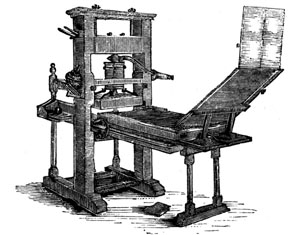
1450 A.D. – The Printing Press (Not Digital)
When Gutenberg introduced the printing press in the 15th century, he revolutionized access to information. The movable type allowed for mass production of books, which had a huge cultural impact. However, like cuneiform, print is still analog. It produces exact copies of information, but the information itself is not broken into digital code. Each printed letter is a physical imprint—not a digital symbol processed through a computing system.
Still, the printing press paved the way for the idea of mass communication, a key step toward the digital age.
1830s – Morse Code (Early Digital)
Now we start to see the emergence of digital concepts. Morse Code, developed in the 1830s, is one of the earliest digital communication systems. It translates language into dots and dashes—discrete signals that can be transmitted across long distances. Each letter and number corresponds to a specific combination of signals.
While it wasn’t binary (it had more than two symbols), Morse Code is digital because it reduces information into standardized, symbolic units. It’s an early example of converting analog information (spoken words) into a digital system for transmission.
1890 – Punch Cards (Digital)
Used for data processing in the 19th and early 20th centuries, punch cards are a strong example of pre-electronic digital technology. Each hole or lack thereof represented a binary state—either a “1” or a “0.” These cards were used in everything from early U.S. Census data processing to IBM’s first machines.
Punch cards are clearly digital: they encode information as discrete units, can be read mechanically, and follow a symbolic logic. They helped lay the groundwork for modern computing.
1940s–1950s – Early Computers (Digital)
The first electronic computers, such as ENIAC and UNIVAC, were groundbreaking because they processed data using binary code. Every instruction or piece of data was broken down into strings of 1s and 0s, processed by vacuum tubes or early transistors.
These machines mark the true birth of the digital age. From here on, we enter a period where information becomes not just recorded, but processed, stored, and transferred digitally.

1970s – Video Game Consoles (Digital)
The rise of consumer electronics like the Atari 2600 introduced digital systems into homes. Video games operate on code—digital instructions executed by microprocessors. Every character movement, score count, and sound effect is determined by digital inputs and outputs.
This is a fully digital experience, both in terms of data and interactivity. Information is no longer just stored or communicated—it’s experienced and manipulated in real-time.
1990s – The World Wide Web (Digital)
With the creation of the internet and the World Wide Web, digital representation reached an entirely new level. Websites, email, and online databases all use digital encoding to store and deliver content. Hypertext, search engines, and hyperlinks made it possible to navigate vast stores of information instantly.
Unlike earlier systems, the web allowed for two-way communication, instant updates, and interactive media—all powered by digital code.
2020s – Artificial Intelligence and NFTs (Digital)
Today, our digital landscape is defined by AI-generated content, blockchain, and virtual identities. NFTs (non-fungible tokens), for instance, are digital representations of ownership on a blockchain. They are fully digital, both in concept and function—there’s no analog counterpart unless you choose to print one out.
AI, meanwhile, uses digital algorithms to simulate decision-making, pattern recognition, and even creativity. These technologies are not just digital in form—they rely on vast amounts of digital data to learn, evolve, and interact with users.
Conclusion: Drawing the Line Between Digital and Not
Classifying objects and concepts as digital or not digital isn’t just about the technology—it’s about how information is structured and handled. Digital systems break the world down into symbolic, countable units that can be stored, transmitted, and manipulated by machines. Analog systems preserve the flow of real life in its full, continuous complexity.
From clay tablets to AI-generated art, we’ve evolved our tools of representation, but each step reflects deeper shifts in how we think, communicate, and connect. Understanding what is and isn’t digital—both historically and today—helps us see the world with sharper awareness and equips us to navigate an increasingly digitized future with purpose and clarity.
Created by: Nick Swaylik
Made with assistance from ChatGPT https://chatgpt.com/